Paper · PCSC · 2025
Speak with Confidence
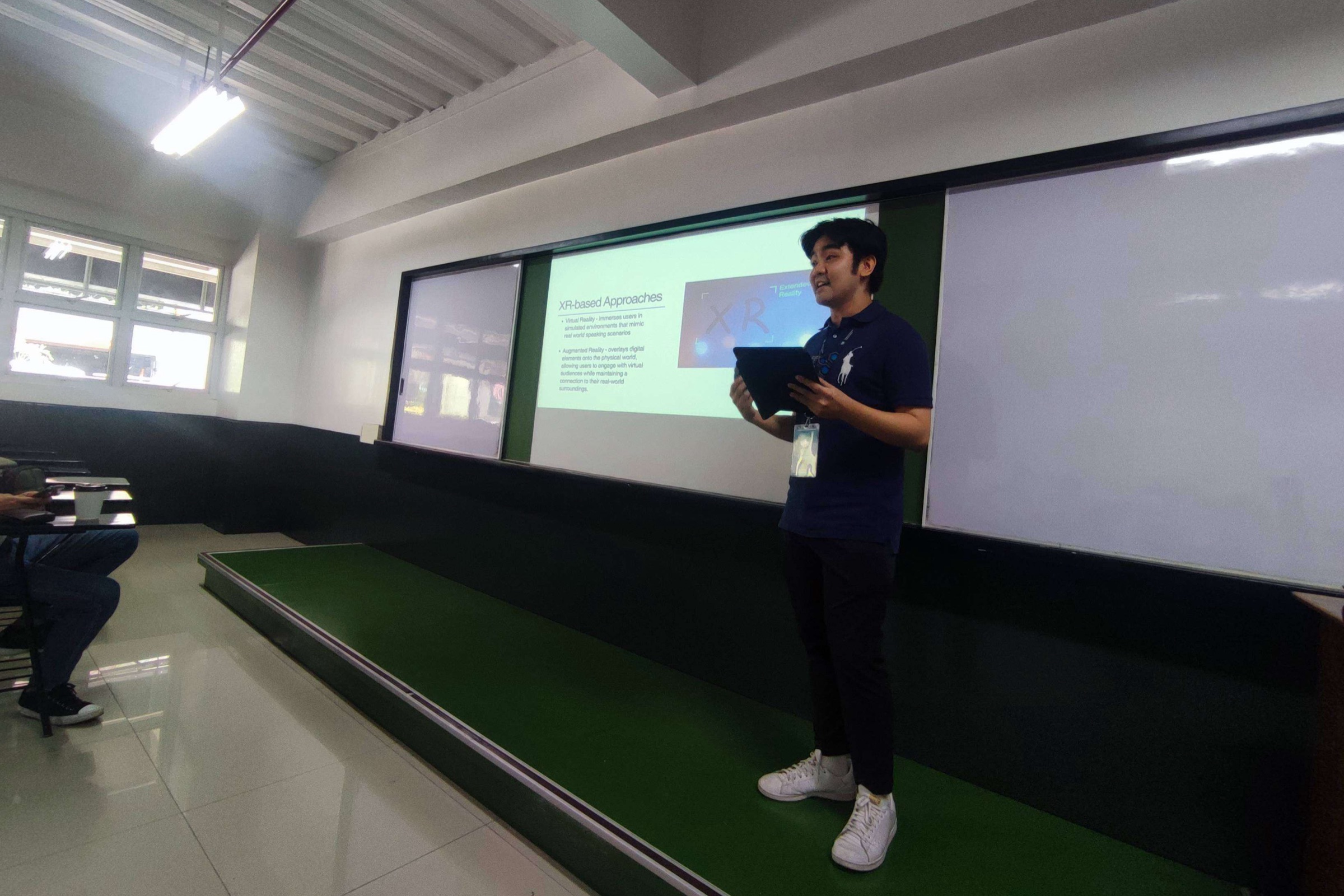
I came up with SpeakAR, an AR app that puts a virtual audience in the room you're rehearsing in, using just a tablet. It started as a class project, and I presented the paper at PCSC 2025 in Baguio.
- Role
- Project lead & co-author
- Stack
- Unity, C#, AR Foundation, Android
- Authors
- Mark Edison Jim, Jan Benjamin Yap, Gian Chill Laolao, Andrei Zachary Lim, Jordan Aiko Deja
- Links
- Paper
- 100%
- of respondents said it could boost their confidence
- PCSC 2025
- presented in Baguio
SpeakAR started as my idea for a class project: an AR app that puts a virtual audience in the room you're rehearsing in, using only a tablet. It became a paper, and I presented it at PCSC 2025 in Baguio. Every respondent in our pilot said it could boost their confidence as a speaker.
I came up with the concept, designed the flow and planned the evaluation. Mark Edison Jim, Gian Chill Laolao and Andrei Zachary Lim helped me bring it to life.
Rehearsing in the room you'll present in
Getting comfortable in front of an audience takes practice in front of one, and that's hard to arrange. Most training tools for this are built for VR, which needs a headset and puts you in a simulated room. I wanted you to rehearse in the actual room you'll present in, with a device you already own. So SpeakAR runs on Android tablets first, and on phones too.
Building an audience
You place virtual people on the real floor around you, then move, resize, rotate or delete them until the room looks like the one you'll face. They're male and female models from the Unity Asset Store, anchored with AR Foundation's plane, anchor and raycast managers so they stay where you put them as you move.
Your slides live inside the AR view, so you can step through your deck while facing the audience instead of looking away at a laptop. The title screen opens on stage curtains over the live camera feed, so starting a session feels like walking on stage. We worked from sketches to a storyboard before building any of it.
What testers taught me
Testers rated having their slides in AR 4.6 out of 5 for how much they needed it, the highest score in the study. One of them put the value of the audience simply: "it can help you pretend that there are actual people, it helps in imagining or visualization."
They also told us the audience was engaging but distracting, because it stood perfectly still. What they asked for was small movement: idle animations, varied poses and facial expressions. That's the lesson I kept from this project. Realism comes from behavior more than from how good the models look.
It was a quick prototype, and the interface shows it. My attention was on the audience, so the UI got the least time. Testers missed the indicator that showed which model was selected, and some didn't realize the slides were already loaded. A proper UI pass is the first thing I'd redo, followed by real slide import and speech feedback on pace and clarity.
Thanks to Mark, Gian and Andrei for building it with me, and to our adviser, Jordan Aiko Deja, who helped us structure the paper for our first conference.
SpeakAR was a first prototype, tested once with a small group of students from a single course, so the findings are early.